
CHP’de “Mutlak Butlan” Krizi: Türkiye’de Devlet Aklının Yeni Dizaynı mı?

Türk siyasetinde bazı krizler vardır; günlük tartışma gibi görünür ama aslında rejimin nasıl işlediğini gösterir. CHP’deki “mutlak butlan” tartışması da tam olarak böyle bir kırılma noktasıdır. Bu mesele yalnızca bir kurultayın iptali ya da parti içi iktidar kavgası değildir. Asıl mesele, Türkiye’de devlet aklının muhalefeti hangi sınırlar içinde görmek istediğiyle ilgilidir. Neorealist perspektiften bakıldığında siyasetin merkezinde idealler değil güç bulunur. Kurumlar, hukuk, partiler ve söylemler; güç dengesini koruyan araçlardır. Devlet dediğimiz yapı ise kendi sürekliliğini her şeyin üzerinde tutar.
Türkiye gibi güçlü tarihsel devlet geleneğine sahip ülkelerde bu refleks daha da belirgindir. Osmanlı’dan Cumhuriyet’e uzanan çizgide devletin temel refleksi hep aynı kaldı: Sistemi tehdit eden belirsizliği kontrol altına almak. Bu nedenle Türkiye’de siyaset hiçbir zaman yalnızca sandık üzerinden işlemedi. Bürokrasi, yargı, güvenlik aygıtı, medya ve ekonomik merkezler de siyasal alanın parçası oldu.
Çok partili hayata geçildikten sonra bile “devletin kabul edilebilir muhalefet sınırı” görünmez biçimde varlığını sürdürdü. Bugün CHP’de yaşanan kriz de bu tarihsel süreklilik içinde okunmalı. 2023 kurultayıyla birlikte CHP’de yalnızca genel başkan değişmedi. Parti sosyolojisi, güç merkezi ve gelecek tahayyülü değişmeye başladı.
Özgür Özel yönetimi ile birlikte partinin ağırlık merkezi klasik Ankara bürokrasisinden büyükşehir belediyelerine kaydı. Özellikle Ekrem İmamoğlu etrafında oluşan yeni siyasal enerji, Türkiye’de ilk kez iktidar değişiminin gerçekçi ihtimal olarak görülmesine yol açtı. İşte tam bu noktada “kurucu unsur” refleksi devreye girdi. Türkiye’de devlet aklı çoğu zaman yalnızca mevcut iktidarı değil, sistemin devamlılığını düşünür. Bu nedenle mesele sadece bir partinin kazanıp kaybetmesi değildir.
Devlet açısından esas soru şudur: “Muhalefet değişebilir; peki sistemin kontrol mimarisi değişecek mi?”
CHP’nin son dönemde yükselen çizgisi, özellikle yerel seçim başarısından sonra, yalnızca seçim kazanan bir muhalefet görüntüsü vermiyordu. Aynı zamanda devlet içindeki güç dağılımını da yeniden şekillendirebilecek bir potansiyel taşıyordu.
Büyükşehir belediyeleri üzerinden oluşan ekonomik ağ, medya etkisi ve genç seçmen mobilizasyonu yeni bir merkez üretiyordu. Neorealist açıdan bakıldığında devlet aklı tam da bu noktada devreye girer:
Belirsizlik büyüdüğünde sistem denge üretir. “Mutlak butlan” tartışması bu yüzden sadece hukukî bir mesele olarak okunamaz. Hukuk burada saf normatif alan değil; güç mücadelesinin kurumsal zemini haline gelir. Türkiye tarihinde bunun örnekleri çoktur: 27 Mayıs sonrası siyasal dizayn, 12 Mart muhtırası, 12 Eylül rejim mühendisliği, 28 Şubat süreci, parti kapatma davaları, Cumhurbaşkanlığı krizleri, Ergenekon/Balyoz dönemleri, kayyum ve yargı tartışmaları…
Her dönemde devlet sistemi kendi istikrarını koruyacak yeni bir denge kurmaya çalıştı. Bugün yaşanan kriz de benzer biçimde okunabilir: Amaç doğrudan CHP’yi yok etmek değil; kontrol edilebilir, öngörülebilir ve sınırları belirli bir muhalefet üretmek olabilir.
Çünkü devlet aklı açısından en riskli senaryo, kurumsal merkezleri aynı anda etkileyebilecek güçlü ve kontrolsüz bir siyasal dalgadır. Burada kritik nokta şudur: Türkiye’de iktidarlar değişebilir; fakat devlet refleksi çoğu zaman kalıcıdır. Bu nedenle önümüzdeki süreçte üç ihtimal öne çıkıyor. Birinci ihtimal, CHP’nin hızlı biçimde yeniden meşruiyet üretmesidir.
Olağanüstü kurultay ya da benzeri bir süreçle parti tabanı yeniden mobilize edilir ve kriz aşılır. Bu durumda CHP mağduriyet üzerinden yeni bir enerji üretir. İkinci ihtimal, çift meşruiyet krizidir. Hukukî meşruiyet ile siyasî meşruiyet ayrışırsa parti uzun süre iç savaş yaşar. Türkiye siyasetinde muhalefetin enerjisi içe kapanır. Bu senaryo iktidarın elini rahatlatır.
Üçüncü ve en stratejik ihtimal ise yeni bir merkez muhalefetin doğmasıdır. Eğer mevcut kriz uzun sürerse CHP yalnızca yönetim krizi yaşamaz; tarihsel kimlik dönüşümüne girer. Parti içinden yeni hareketler çıkabilir. Türkiye’de merkez siyaset yeniden şekillenebilir.
Ancak hangi senaryo gerçekleşirse gerçekleşsin, bu kriz bize şunu gösterdi: Türkiye’de siyaset hâlâ yalnızca sandıkta kurulup sandıkta bitmiyor. Devlet, kurucu refleksleriyle oyunun sınırlarını belirlemeye devam ediyor.
Muhalefet ise yalnızca seçim kazanmanın değil, devlet mimarisiyle uyumlu yeni bir güç dengesi kurmanın yollarını arıyor. Belki de “mutlak butlan” tartışmasının asıl anlamı burada yatıyor: Türkiye’de artık yalnızca iktidarın değil, muhalefetin nasıl iktidar olacağı da sistemin temel meselesi haline geldi.
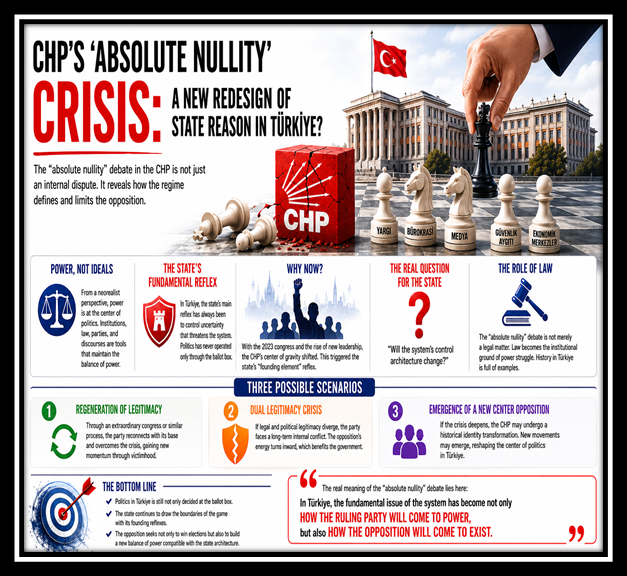
The "Absolute Nullity" Crisis in the CHP: A New Design of State Reason in Turkey?
There are certain crises in Turkish politics; they may seem like daily debates, but they actually reveal how the regime operates. The "absolute nullity" debate in the CHP is precisely such a breaking point. This issue is not merely the cancellation of a congress or an internal power struggle within the party. The real issue concerns the boundaries within which the state reason in Turkey wants to see the opposition. From a neorealist perspective, power, not ideals, is at the center of politics. Institutions, law, parties, and discourses are tools that maintain the balance of power.
The structure we call the state prioritizes its own continuity above all else. This reflex is even more pronounced in countries with a strong historical state tradition like Turkey. In the line extending from the Ottoman Empire to the Republic, the state's fundamental reflex has always remained the same: To control the uncertainty that threatens the system.
Therefore, politics in Turkey has never operated solely through the ballot box. The bureaucracy, the judiciary, the security apparatus, the media, and economic centers have also become part of the political sphere. Even after the transition to a multi-party system, the "state's acceptable limit for opposition" invisibly persisted. The current crisis in the CHP should be read within this historical continuity.
With the 2023 congress, not only did the party leader change, but the party's sociology, power center, and future vision began to shift. With Özgür Özel's leadership, the party's center of gravity shifted from the classic Ankara bureaucracy to the metropolitan municipalities. The new political energy, particularly around Ekrem İmamoğlu, led to the realization of a change of power as a realistic possibility for the first time in Turkey. It is precisely at this point that the "founding element" reflex came into play. In Turkey, the state often considers not only the current government but also the continuity of the system.
Therefore, the issue is not simply whether a party wins or loses. The main question for the state is: "The opposition may change; but will the system's control architecture change?" The CHP's recent rise, especially after its success in the local elections, did not only present the image of an opposition that won elections. It also carried the potential to reshape the distribution of power within the state.
The economic network formed through metropolitan municipalities, media influence, and the mobilization of young voters were creating a new center. From a neorealist perspective, this is precisely where state reason comes into play: When uncertainty grows, the system produces equilibrium. Therefore, the "absolute nullity" debate cannot be read solely as a legal matter. Law here is not a purely normative field; it becomes the institutional ground of the power struggle.
There are many examples of this in Turkish history: the political design after May 27th, the March 12th memorandum, the September 12th regime engineering, the February 28th process, party closure cases, presidential crises, the Ergenekon/Balyoz periods, the debates on trustees and the judiciary… In every period, the state system has tried to establish a new equilibrium to maintain its own stability.
The current crisis can be read similarly: The aim may not be to directly destroy the CHP; it may be to produce a controllable, predictable, and limited opposition. Because from the perspective of state reason, the riskiest scenario is a strong and uncontrolled political wave that can simultaneously affect institutional centers. The critical point here is this: Governments may change in Turkey; however, the state's reflexes are often permanent. Therefore, three possibilities stand out in the upcoming period.
The first possibility is that the CHP quickly regenerates its legitimacy. Through an extraordinary congress or a similar process, the party base is mobilized again and the crisis is overcome. In this case, the CHP generates new energy through victimhood. The second possibility is a dual legitimacy crisis. If legal legitimacy and political legitimacy diverge, the party will experience internal conflict for a long time. The energy of the opposition in Turkish politics becomes inward-looking. This scenario eases the hand of the government.
The third and most strategic possibility is the emergence of a new center opposition. If the current crisis lasts a long time, the CHP will not only experience a management crisis; it will undergo a historical identity transformation. New movements may emerge from within the party.
Center politics in Turkey may be reshaped. However, whichever scenario occurs, this crisis has shown us this: Politics in Turkey is still not only established and ended at the ballot box. The state continues to determine the boundaries of the game with its founding reflexes. The opposition, however, is seeking ways not only to win elections but also to establish a new balance of power compatible with the state architecture.
Perhaps the real meaning of the "absolute nullity" debate lies here: In Turkey, the fundamental issue of the system has become not only how the ruling party will come to power, but also how the opposition will come to power.

Yazarın Diğer Yazıları
- Rusya Almanya'yı Vuracak mı? Belarus'tan Berline'e Bir Savaş Senaryosu
- Türkiye Ebu Zuhur’a mı, yoksa başka bir noktaya mı üs kuracak?
- Türkiye sınır ötesi harekata mı hazırlanıyor?
- Bir Hareket Ne Zaman Suç Üreten Bir Yapıya Dönüşür?
- 2026 Ortadoğu’sunda aslan kim geyik kim?
- Ortadoğu’daki bu görünmez el kimin?
- Mekke Anlaşması: Üç Devlet Birbirine Neden Güvensin?
- Toplumsal Çevreleme Doktrini: İspanya